With Retarus Email-to-SMS, you can send SMS messages directly from your email client to mobile phone numbers. The service works with standard email applications, including Microsoft Outlook and Microsoft 365.
When you send an email through the Retarus gateway, Email-to-SMS converts it into an SMS and delivers it to the recipient's mobile device.
The SMS content can come from the email subject line, the email body, or both. Each SMS can contain up to 160 characters. If the content exceeds this limit, Retarus truncates the message.
Addressing an Email-to-SMS
To send an SMS by email, enter the recipient’s mobile number in one of the following formats:
-
Microsoft Exchange
[SMS: [country code] [mobile phone number]]
-
Other email clients, including Microsoft Outlook
[mobile phone number]@sms.retarus.com
Include the mobile network prefix when required, such as 0151 for German mobile phone numbers. When sending an SMS within the same country, you don't need to include the country code.
Example addressing formats
0176xxxxxxxx@sms.retarus.com
0049176xxxxxxxx@sms.retarus.com
[SMS:0049151xxxxxxxx]

In the examples above, x represents any digit from 0 to 9. The country code 0049 is the code for Germany, while 0176 is a German mobile phone number prefix. Not all countries use mobile phone prefixes. For example, in the United States, you cannot distinguish mobile and fixed-line numbers by their format alone.
You can send an SMS message to up to 3,000 recipients by either:
-
Adding mobile numbers individually
-
Using a distribution list
When you use a distribution list, all recipients are processed as a single submission. You receive one cumulative delivery report for the entire submission instead of a separate report for each recipient.
After Retarus successfully receives your message, you receive an email confirmation.
Sending SMS to a distribution list
With Email-to-SMS, you can send personalized messages to everyone on a distribution list without addressing each recipient individually. To send SMS messages to a distribution list, you need three files:
-
Distribution list
Contains the recipients and their mobile phone numbers. -
Body attachment
Defines the content of your SMS. -
Command attachment
Contains the information used to generate delivery reports.
You can use placeholders in the body attachment to personalize the SMS for each recipient.
Distribution lists
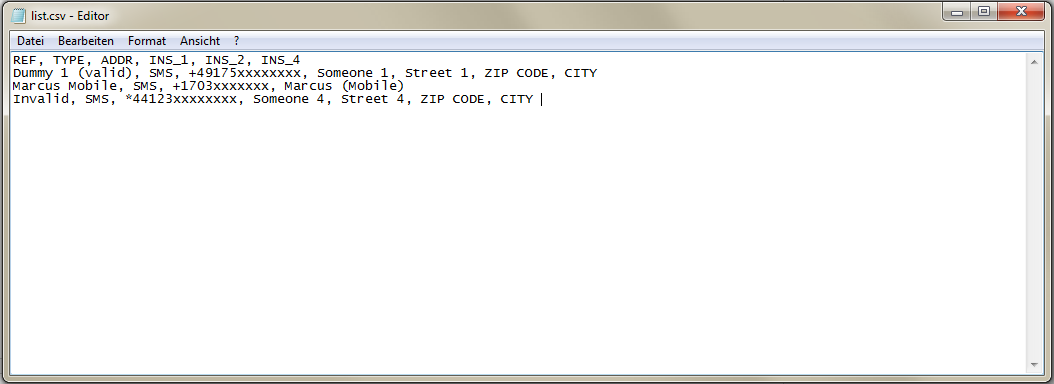
Save the distribution list as a CSV file named list.csv. When you send an SMS using a distribution list, use the following address instead of individual recipient numbers: list@sms.retarus.com.
You can add as many personalization columns as needed. Retarus inserts the values from these columns into the SMS when you send it.
Each line of the distribution list must contain the following mandatory fields:
-
REF
-
TYPE
-
ADDR
The table below describes each column in the distribution list.
|
Column name |
Description |
|---|---|
|
REF |
Reference information used to associate the SMS number with the delivery report. You can enter identifying information, such as the recipient's name. |
|
TYPE |
Defines the transmission medium. Always enter SMS. |
|
ADDR |
Specifies the recipient’s mobile phone number. |
|
INS_(Number) |
Personalization field that you can customize as needed. |
Body attachment
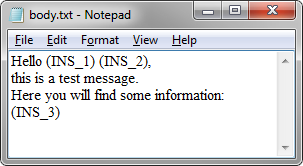
The body attachment file is required as it contains the personalized SMS message content. When creating this file:
The body attachment contains the SMS content, including any personalized information. Create the file as follows:
-
Make sure each personalization field matches the corresponding column name in the distribution list exactly.
-
Save the file in TXT format and attach it to the email you send.
Command attachment
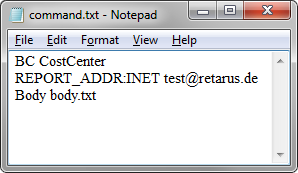
The command attachment is a TXT file that contains the control information for your SMS transmission. Include the following fields:
|
Column name |
Description |
|---|---|
|
BC |
Specifies the cost center for the transmission. |
|
REPORT_ADDR:INET |
Specifies the email address for the delivery report. If you enter an address, Retarus sends the report to that address. If you leave the field blank, Retarus sends the report to the default recipient configured in the EAS portal. |
|
Body |
Specifies the name of the file that contains the personalized SMS text. |
Special SMS transmission settings
You can control various aspects of an SMS transmission by adding commands to the email subject line. These commands override the corresponding settings configured in the EAS portal.
|
Function |
Options/additional information |
Command in the subject line |
|---|---|---|
|
Status request |
Sends an email delivery notification to the sender (on or off). |
|
|
Validity |
Specifies how long Retarus attempts to deliver the message if the initial attempt is unsuccessful. Enter a value from 0 to 9 hours. |
|
|
Quality of Service |
Sets transmission priority to express or normal. You can also set the SMS priority using your email client's priority settings. |
|
|
Duplicate detection |
Prevents duplicate transmissions (on or off). |
|
|
Schedule timestamp (ISO-8601) |
Specifies when Retarus should send the message. Use ISO-8601 format. |
|
|
Sender ID |
Specifies the sender ID displayed to the recipient. |
|
|
Blackout periods (ISO-8601) |
Specifies periods during which Retarus should not send messages. Use ISO-8601 format. |
|
|
Flash transmission |
Displays the SMS directly on the recipient’s display (on or off). A flash transmission displays the SMS directly on the recipient's screen. However, not all mobile devices and mobile service providers support this feature. |
|
|
Billing Code |
Specifies a billing code for invoicing. |
|
|
Customer Reference |
Adds reference information to the job. |
|
Reports
Transmission report
When you use Email-to-SMS, you receive a notification email confirming whether Retarus successfully received your message. If Retarus rejects the message, the notification explains the reason, such as an invalid mobile phone number format. It also includes a complete list of the intended SMS recipients.
Transmission report statuses
The following table describes the status indicators in your report emails.
-
If you enter the SMS text in the subject line, the status appears in the subject line.
-
If you enter the text in the email body, the status appears in the body.
|
Status |
Significance |
|---|---|
|
accepted |
The message for the specified recipient was successfully handed over to Retarus. |
|
rejected |
The message could not be transferred. The email provides the reason for the rejection, such as a syntax error. |
Status requests and notification
When you request a status notification, Retarus sends an additional email after the SMS transmission is complete. This email confirms whether the message was delivered.
The email uses the following format:
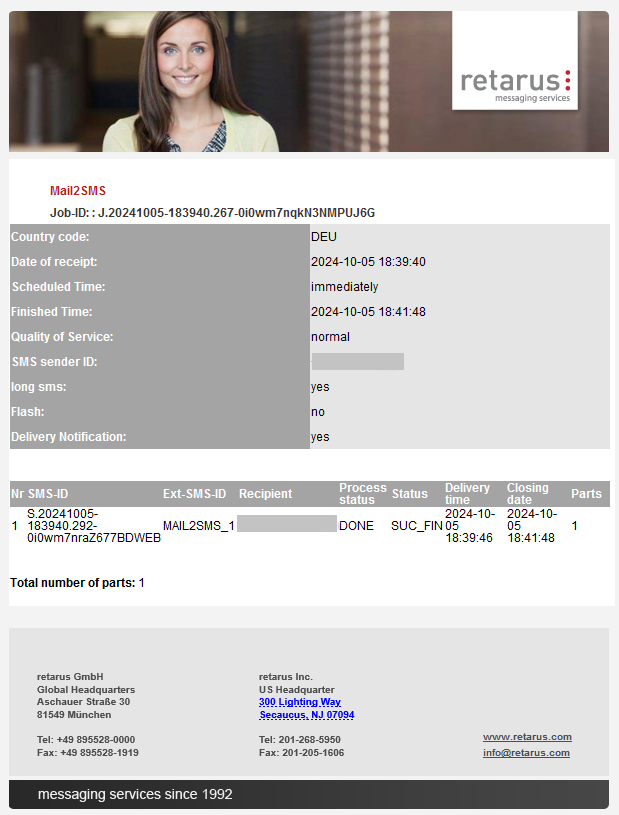
Delivery confirmation statuses
Status notifications appear in email notifications and monthly reports. The table below describes the possible status messages and their meanings.
|
Status |
Significance |
|---|---|
|
DONE SUC_FIN |
The message was successfully delivered to the recipient’s device. |
|
DONE INVALID_DST |
The recipient’s number is invalid, so the message could not be delivered. |
|
DONE BLOCKED |
The recipient’s number is blocked, so the message could not be delivered. |
|
DONE TIMEOUT |
Retarus did not receive a final delivery confirmation within the specified timeframe. The message may not have been delivered, for example, because the recipient's phone was turned off. |
|
DONE FAILED_FIN |
The message could not be delivered. |
|
DONE SEND_ERR |
The recipient’s device does not provide delivery confirmation. The message may still have been delivered successfully. |
Character sets
Retarus Email-to-SMS uses GSM-7 by default for single-part SMS messages of up to 160 characters. For concatenated (multi-part) SMS messages, each segment can contain up to 153 characters.
If your message contains special characters or non-Western scripts, such as Asian or other non-Latin scripts, you can use UTF-16 encoding instead.
-
Single-part UTF-16 SMS: Up to 70 characters
-
Concatenated UTF-16 SMS: Up to 67 characters per segment
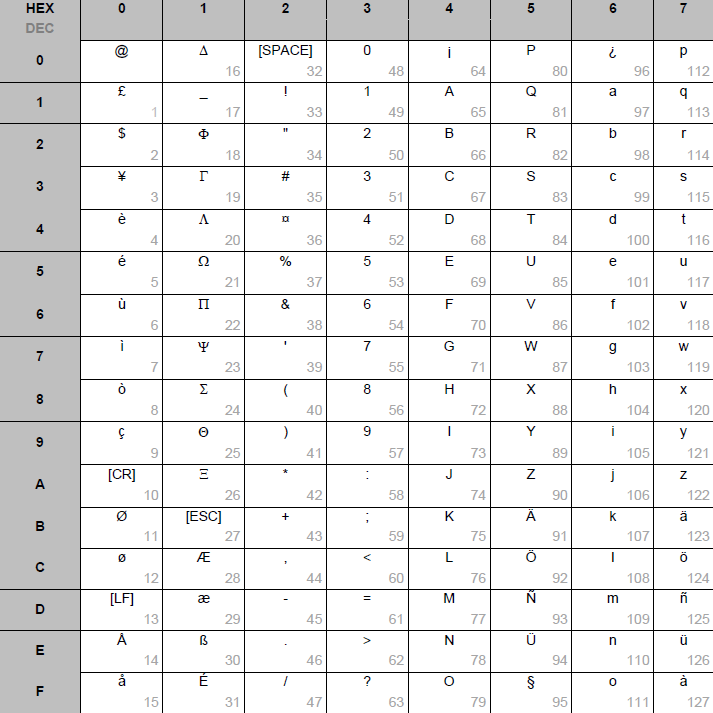
The tables below list:
-
Characters supported by the GSM-7 standard character set
-
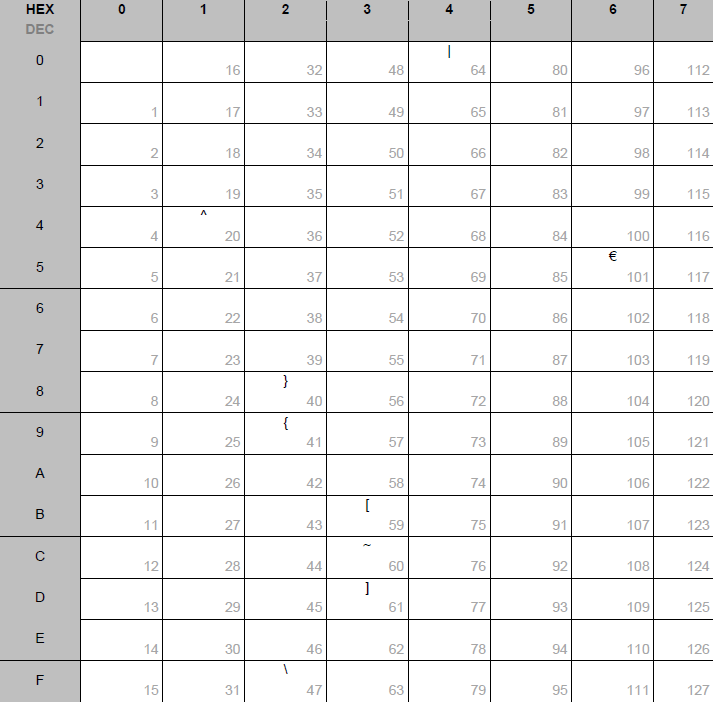
Special characters that count as two characters
GSM 7-bit standard character set
Special character set